Writers need to have a thick skin when it comes to receiving criticism. Personally, I value every review that any reader has posted on Amazon, whether positive or negative. Of course, positive reviews help sell books. More importantly, negative reviews, if the author listens to his or her audience, can help make future books better. For if we do not learn from our mistakes, we will be doomed to repeat them. My philosophy is when anyone takes the time and goes to the trouble of writing a review of something I've written, I tend to pay attention, even more so to critique than praise. As an example, even though my novel Secondhand Sight won a Readers' Favorite gold medal for Fiction/Horror, I thought the comments on Amazon were very fair criticisms when some readers suggested the sections that described tennis activities intended to provide local color were too long. Those lengthy sections really only served as plot devices that got the protagonist out of his house and could have been achieved with at least a thousand fewer words, to be perfectly honest. It was Shakespeare who, as Polonius in Hamlet, famously said, "...brevity is the soul of wit." As a result of listening to those readers, in my novel titled Premonition that followed Secondhand Sight, my editors and I worked even harder to trim every scrap of unnecessary fat from the manuscript. Our goal was to establish a steady pace that never lagged, increasing speed as we moved from start to finish, which I hope to have accomplished, thanks to the feedback from readers. Once again, we will … [Read more...]
The probability problem
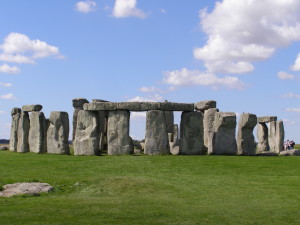
The fallacy in Paley's famous Watchmaker analogy was not that the Watchmaker was blind, as Richard Dawkins has suggested. The problem is that Paley's analogy assumed the rock could have always existed in an eternal universe, whereas if physicists are correct and the Big Bang created our universe, we can safely assume the rock has not. No one is certain why a prehistoric civilization built a monument that we call Stonehenge, but we know this peculiar rock formation exists, because we've all seen pictures of it and can easily visit the physical location. Was it a temple to worship the sun? A giant calendar? An ancient medical center? Nobody knows who built Stonehenge, or why it was constructed. We can rather safely assume that someone built it, though. Or can we? What makes us so certain that Stonehenge isn't merely a natural rock formation somehow created miraculously by the vagaries of Time? Because if you listen to Richard Dawkins explain the probability problems associated with our existential questions, he seems to be saying that as long as something is theoretically possible, it doesn't really matter how improbable the event in question might be. What makes us so sure that Stonehenge is not a naturally occurring rock formation? Well, it is extremely unlikely, no matter well how you craft any alternate explanation. The rocks that form Stonehenge appear to have been quarried from a location several miles away. The rocks that form Stonehenge shouldn't be where they are -- unless humans put them there. The rocks shouldn't be stacked and apparently … [Read more...]
Lacking the courage of one’s convictions
Obviously, Professor A. C. Grayling must be a very busy man. I don't doubt that teaching, writing, and interviews keeps him quite busy. However, I confess that I am finding it very difficult to believe that his schedule has been completely booked for the rest of his life. I simply can't understand why he can't carve out a few hours of spare time to burst my bubble of egotistical pride, by demonstrating the intellectual superiority of his atheistic humanism once and for all. After reading his book and blogging about it twice because I appreciated the skill of its authorship, I grew bold and wrote the good professor to propose a written debate that would pit his GOD Argument versus my Counterargument for God. You see, I paid attention when I read his book. I believe that already know much of what the professor might say, and it gave me the confidence to approach him. I am quite convinced that my counterargument can defeat his argument, even though my book was originally intended to rebut The God Delusion of Richard Dawkins. So when Grayling's first assistant asked me to define the parameters for the debate I proposed admittedly, my hopes rose. My reply suggested that Professor Grayling could set the debate parameters for debate himself. My offer said that we could schedule our discussion for any future exchange at his convenience. So you might imagine my surprise when his second assistant replied and said that it would never be convenient. Not even sometime in late 2016? I asked. Nope. Never, as in never, ever. Please forgive me for stating … [Read more...]
Heaven Is for Real

Some atheists seem to think that if they relentlessly attack theists and blame God for all the evil in the world, they will eventually succeed and completely eradicate all religious beliefs. Frankly, that will never happen. The goal is simply unattainable. As long as people inhabit the earth, at least some of them will believe in a supernatural God. Nevertheless, a rather persistent atheist acquaintance recently posted links to several news stories on Facebook about mothers who had allegedly murdered their own kids because they wanted the children to go to heaven. His argument apparently was that religious beliefs, not mental illness, motivated these women to commit such heinous crimes. Now were the situation reversed -- for example, if I insinuated that people who believe Darwinian theory explains their existence were all prone to become serial-killing atheist cannibals and used Jeffrey Dahmer as an example, I would be committing the same flawed, illogical "guilt by association" argument my acquaintance had attempted. And that would be just as juvenile, and wrong. Two wrongs don't make a right. Nor do two left turns, but three do. This acquaintance went so far to direct a question specifically to me, asking, "how many more have to die before someone says 'Stop!' This heaven stuff isn't real?" My reply was to say that I believe heaven is for real. However, I also know that I can't prove it any more than an evolutionary biologist can prove that I share a common ancestor with an oak tree. I won't claim to know heaven exists beyond all doubt, because … [Read more...]
The Christmas Truce

Evangelists of atheism have often suggested that religion has been responsible for much of the pain and suffering we observe in this world. That belief is badly mistaken -- it is actually the polar opposite of the truth. There is evidence that suggests if Christian spirit were allowed to rule the world, there might truly be peace on earth. The true story of the 1914 Christmas Truce reminds us that peace IS possible, but only for men of good will. Peace doesn't come from wishful thinking. A century ago, all was quiet on the Western front. The first war that involved the whole world had almost ended as quickly as it began. And Christian spirit was largely responsible. The night was Christmas Eve, 1914. Only five months after World War I began, British and German soldiers were dug into trenches formed along the Western front, where they watched each other from a relatively safe distance. Bodies littered the barren turf of no-man's land separating the two armies. Naturally, the British troops were quite surprised when they heard the Germans begin to sing in the quiet night. They knew the tune, but the words were in a foreign language. Private Frank Sumter was one of the first to recognize the Christmas carol. Years later, he recalled the occasion, saying, "...and then we heard the Germans singing Silent Night, Holy Night. I said, "C'mon, boys. Let's join in with the song." Soon soldiers from both sides were joyfully singing the same hymn together, but in different languages. Then on Christmas morning, a German soldier tentatively emerged from the … [Read more...]