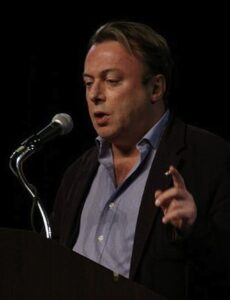
The late Christopher Hitchens, may he rest in peace, was a popular journalist and outspoken atheist probably most famous for writing the 2007 book titled "God is not Great." Much like Richard Dawkins, his fellow member of the atheistic quartet known as the Four Horsemen, Hitchens made sure the word "God" was the smallest text on his book cover, wanting to make sure his contempt for God was known to everyone willing to listen to him. Not only did Hitchens achieve fame as a writer, he was also considered by many to be a formidable debate opponent, possibly because he was very eloquent, had strong command of the English language, and spoke really fast. Words just effortlessly flowed from his mouth. True, Hitchens was clever, eloquent, and he spoke very fast. But brilliant? That is debatable. For example, during a debate Hitchens once asked, "Why do we have religion in the first place? Why are we having this discussion? Because we are pattern-seeking mammals. It's part of our evolution. We look for patterns. We're designed to look for them and if we can't find a good explanation, we'll come up with a bad one rather than none at all. Most people would rather have a conspiracy theory than no theory. It's very observable that there's a lot of junk science around before good science arrives. Before we have astronomy we have astrology. Before we have chemistry we have alchemy. All these things are derivatives of religion because in a very sinister verse in the Bible that used to upset me when I was forced to listen to it as a little boy. It says, "Seek and ye shall … [Read more...]
The Unplanned Universe is Mathematically Impossible
We know the universe had an origin or a beginning. Science calls this singularity the "Big Bang" theory, a term originally coined by a very famous scientist (and atheist) named Fred Hoyle. Sir Fred Hoyle Hoyle was mocking the idea that our universe could have had an origin because at that time it was believed our universe was too complex to have had a beginning. The eternal or "steady state" universe was preferred by scientists and intellectuals because the universe with an origin required too much to explain. Hoyle had lots of company with him in agreement in their belief that the universe was eternal, including the atheist philosopher Bertrand Russell. Even very smart people are humans, and all humans make mistakes, both honestly and dishonestly. However, after seeing the evidence for the Big Bang, Hoyle drastically changed his tune and said this: "Some super-calculating intellect must have designed the properties of the carbon atom. Otherwise, the chance of my finding such an atom through the blind forces of nature would be utterly miniscule. A commonsense interpretation of the facts suggests that a super-intellect has monkeyed with physics, as well as chemistry and biology and that there are no blind forces worth speaking about in nature. The numbers one calculates from the facts seem to me so overwhelming as to put this conclusion almost beyond question." Hoyle, Fred, "The Universe: Past and Present Reflections. "Engineering and Science", November 1981. pgs. 8–12. I felt this quote by Dr. Hoyle was so important that I included it in my book The God … [Read more...]
Probability and odds
Probably (pun intended) the most difficult part of my argument for God is to properly convey the unlikelihood of our universe forming because of an unplanned and undirected sequence of events. The odds against the existence of our universe are literally astronomical. Even so, I may have finally stumbled upon a way to present the improbability in language anyone can understand, or layman's terms, using the NCAA basketball tournament popularly known as "March Madness." Recently, ESPN published a rather remarkable story about an otherwise unremarkable neuropsychologist named Gregg Nigl. What was Mr. Nigl's specific claim to fame? Had he made some innovative medical discovery that was some groundbreaking innovation in the world of sports? No. No skill was involved in his otherwise noteworthy "accomplishment." Did he break some unique sports record like hitting the most bullseyes in a game of darts, or somehow make his mark in the Guinness Book of World Records? Nope, that wasn't it, either. What did Gregg Nigl do in 2019 that was so remarkable? He was the first person known to have gone a perfect 48-0 in predictions through two rounds of the NCAA tournament. The odds against picking a perfect NCAA tournament bracket have been estimated as between a somewhat modest 1 in 120 billion for an experienced gambler to correctly guess all the tournament winners to treating the outcome of every game as a coin flip. Those "coin flip" odds have been estimated to be a stunning 1 in 9.2 quintillion. But in 2019 for the first time in history, Nigl's picks were perfect … [Read more...]
A reason for the problem of evil

I'm not a preacher. I like to write books. I've never claimed to be an evangelist and I have no formal training in theology. When people ask me questions and I don't know the answers, I'll just say, "I don't know!" because it's the truth. Of all the questions you could ask me, my least favorite is "Why does God allow people to suffer pain? What is the purpose of evil?" My go-to answer for that has always felt like sort of a cop out in my opinion, even though I believe it's true: free will. God has given us this tremendous gift of free will and permitted us the choice between good and evil. I've often said that without pain, we cannot understand pleasure. Without sorrow, we do not appreciate joy. If we've never experienced hate, we have no true concept of love. All this is true. But is that a sufficient answer to the question? Why does evil exist? Why are humans often cruel? Why doesn't God just turn the Earth into Heaven and make everything good? Earlier this morning I watched two short videos I shared on my Facebook page called The God Conclusion, and a "Eureka!" moment occurred to me, although I have managed to refrain from running naked down the street shouting about it at the top of my lungs. The two videos had the same basic message: when we ask God for strength, should God just magically make us stronger, or should He give us difficulties that will ultimately make us stronger? When we ask for wisdom, should God simply make us wiser or give us problems to solve that ultimately make us smarter? If we ask God for courage, should He … [Read more...]